Friday, October 23, 2015

Lichens - short course in Wenvoe

Wenvoe Wildlife Group have organised a short course on Lichens on Saturday 14th November.

It is just two hours: from 10.30am to 12.30pm.

It will start with an indoor introduction to Lichens, before we go out to see which ones we can find in Wenvoe.

No experience necessary - this is ideal for anyone wanting to find out about these fascinating life forms.

It will be led by Barbara Brown of the Natural History Museum's OPAL project.

Anyone can come and the course is free, but places must be booked.

To book and for further details e-mail: bruce7@btinternet.com


Monday, October 19, 2015

Hedgehog Rescue and Conservation

CHECK YOUR BONFIRE BEFORE LIGHTING IT !

We had an absolutely wonderful talk last Monday on Hedgehog rescue and conservation by Erica Dixon from http://www.hedgehoghelpline.org.uk/ 

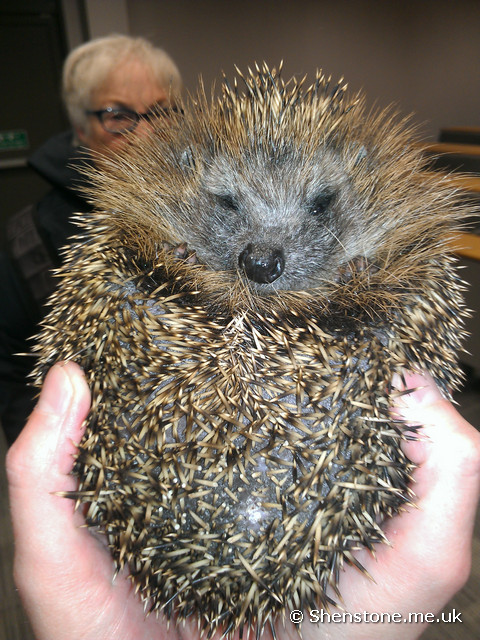
She was helped in the talk by Poppy the hedgehog who is an unfortunate victim of an accident and has been blinded though a bad head injury, but is otherwise healthy. You can see Poppy being posed for in the pictures below (of course with her injury she was not aware she was being photographed)

The work that the helpline do is wonderful and we had some facts about them and how they were born with spines, and some fascinating information on how you care for an animal that is only days old. It takes a lot of dedication !

We were all then very sad to hear just how much they were needed to be called on given how rare hedgehogs are getting.  Hedgehogs were abundant throughout Britain, with an estimated population of perhaps 30 million in the 1950s. By 1995, the population was estimated to be only about  1.5 million and declining again since then


We were shown some awful pictures of injured animals and we had a very apt reminder of the need to check bonfires before being cheered up with some pictures of success stories and happy hogs being released.

Poppy as has been said is not able to be released so she is being kept to entertain people like us on an occasional basis and spends most of her time in a nice secure garden. She was happy to be awake because with no eyes she has lost perception of the time of day.


All in all a fascinating talk and I know a number of our members exchanged information about being a release site or becoming a helper. if you want more information then take a look at their website


Monday, October 12, 2015

Zoe Melvin wins Bioscience Prize 2015


Bioscience Prize 2015

The Bioscience Prize is awarded annually by Cardiff Naturalists' Society in the memory of former member Prof Ursula Henriques, for the best 2nd-year fieldwork project in the Bioscience Department at Cardiff University. Andy Kendall presented Zoe Melvin with the 2015 award (below) at the CNS meeting on Monday 28 Sept, during which Zoe gave a talk about her project on mosquitoes in Borneo. Zoe has written an article, based on her talk, which will feature in the next CNS newsletter.


Wednesday, September 30, 2015

The Curious Case of the Shrinking Violet

by Bruce McDonald

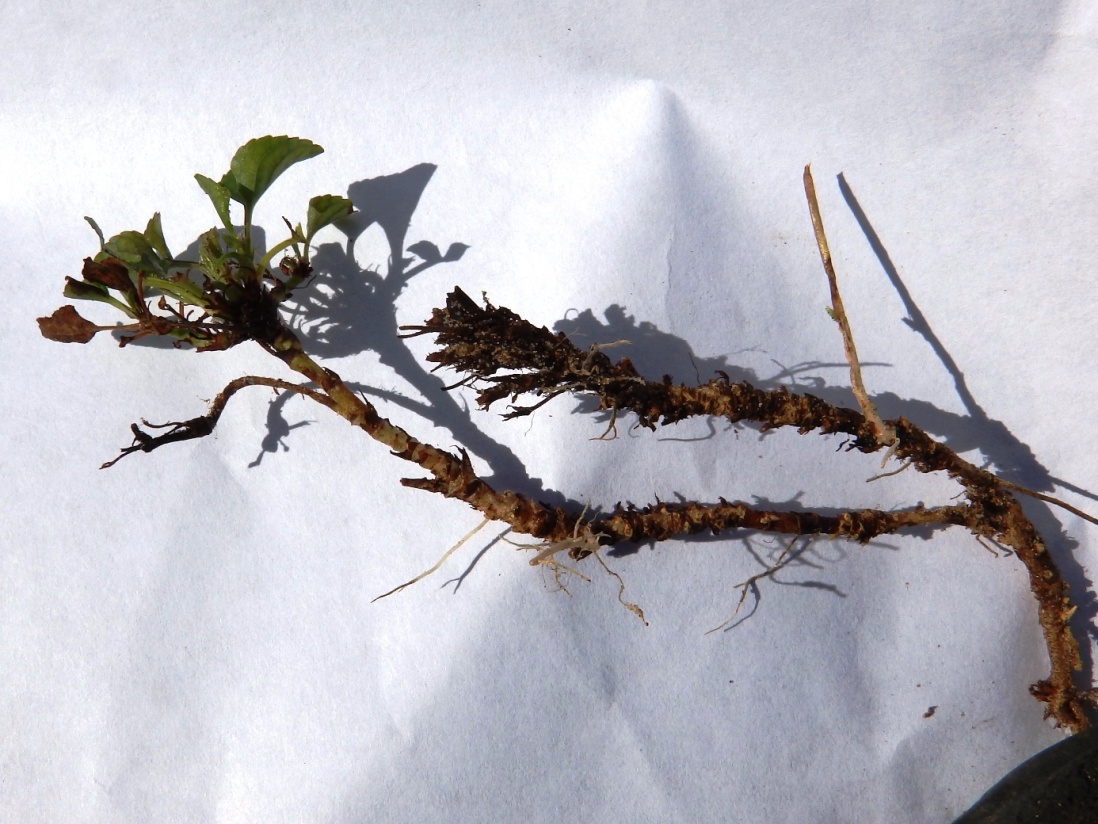
Vaguely familiar? You know how it is, you see something that rings a bell but you can't quite put a finger on it. In amongst the dunes between Rhossili and Broughton beaches on Gower were some low patches of a plant shown in the photo. Some individual plants, some clumps with trailing stems. Not much to go on so take a photo and consult the books. Nothing obvious in the books so have a look at the photos. A few pieces (small - just 2 millimetres) of something withered and rust-coloured. Close-up on these - just shrivelled, well, could be anything. Hang on - alongside these a flower! Tiny - I could not even see them when looking at the plants in the dunes. Quite distinctive but odd. Back to the books - nothing.


Call in the experts. A quick response from Julian Woodman - some sort of Violet. Of course; no wonder the leaves were familiar. Also a little way back along the flower stem a couple of very small bracteoles - another Viola clue. More research - possibly a hybrid? There are tables of hybrids on the Wildflowerfinder website. But nothing really fits the bill. And the odd puzzle - if they were hybrids would one not expect to see some parent plants around? Find an Oxlip (the hybrid) and you are bound to see some Primroses and Cowslips in the vicinity. But here - nothing. The only Violas were Wild Pansies and they bore few resemblances to our specimens. So, back to the dunes for some further observations.

Another observation. On one plant a seed pod - suggests viability.


A rough count. About 30 plants in an area of 20 square metres - they seem to be prospering. Another look at the stems - runners! But are they rooting?


Take a small plant and tease it out of the sand - possible rhizome?


All the plants seem to be like this - are they all connected? Short of digging up a couple of sand dunes we will not know.

Hmmm! Where now? More Google delving and then, Eureka! A website image of a flower looking very similar to ours and the magic word 'Cleistogamous'. Wikipedia is on hand to clarify - 'Cleistogamy or automatic self-pollination describes the trait of certain plants to propagate by using non-opening self-pollinating flowers. Especially well known in peanuts, peas and beans this behavior is most widespread in the grass family. However, the largest genus of cleistogamous plants is actually Viola' - voila! The opposite is Chasmogamy with open flowers, nectar and pollen but this is relatively expensive in terms of energy.

Wiki goes on to comment that Cleistogamy often occurs in unfavourable sites or adverse conditions. Heavy grazing by livestock or deer or shortage of light may bring on a bout of self-pollination. So the probability is that these violets have become Cleistogamous  because they are growing in nutrient-poor sand-dunes.

Where next? Take a specimen and grow it on in a more nutritious loam - if 'normal' violets appear that will tend to support the argument as well as helping to clarify which variety this is. Also check earlier in the year to see if they do produce conventional flowers in the dunes before reverting to Cleistogamy late Summer. 

Text and Photos by Bruce McDonald

Monday, September 7, 2015

Newsletter 105 is now online

It went to members a few weeks ago, and is now offered more widely in the hope that you will find something of interest and will want to join us at one of our indoor meetings or outdoor events

you can find it by CLICKING HERE 

Tuesday, June 23, 2015

Tortworth Arboretum

By Bruce McDonald

With just a few days to go before our trip to Tortworth, on Sunday 31 May, the weather forecast was dire - would it go ahead? In the event the weather relented and we enjoyed a day at this amazing arboretum led by the irrepressible Tony Titchen, an ideal guide for this collection as he had been involved with the identification and cataloguing of the trees in the past. We had invited members of our other groups and were delighted to be joined by representatives from Bristol Naturalists, Gloucester Naturalists and Friends of Dyffryn Gardens.


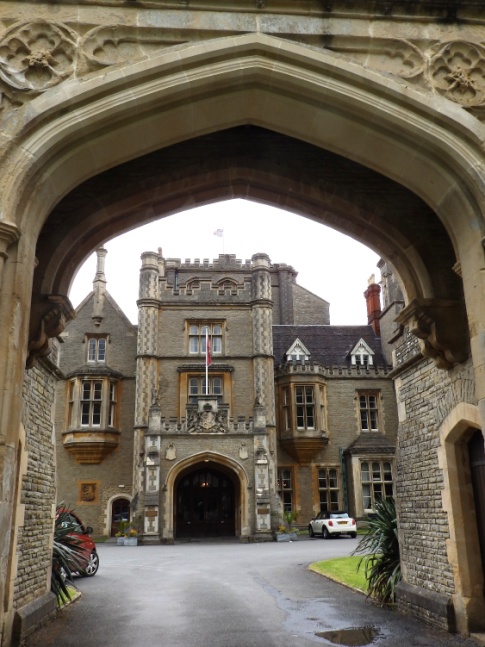
For those unfamiliar with the location, the arboretum is in the grounds of the Tortworth Court Hotel near Wotton under Edge and a convenient 45 minute drive from Cardiff. There is plenty of history to this place as Tony pointed out. As far back as Edward I's reign (1272 - 1307) the manor of Tortworth belonged to Sir Nicholas Kingston. The Veel family held it for 200 years when it included a deer park; then the Throckmortons and finally the Ducie family who owned it for 350 years. The house itself was built between 1849 and 1853 by the 2nd Earl and was designed by Samuel Teulon. During the Second World War the building was used first by Royal Navy as a training establishment when it was referred to as HMS Cabbala. Next, American servicemen took up residence and it was at this point that some of arboretum trees were lost due to the spillage of vehicle oil. In 1991 the house was bought by Phillip Stubbs but a disastrous fire caused widespread damage. The structure was then purchased by Four Pillars Hotels and their restoration is what you see today.


And now to the purpose of our visit: the arboretum itself. Whilst some mature trees predate the arboretum it was the 3rd Earl who started planting in 1853 and created an arboretum which at the time was a rival to Westonbirt. Our tour started with a Robinia pseudoacacia (below) but this was the contorted form 'tortuosa'. Robinia originates in the Eastern and mid-Western USA arriving in Europe in the 17th Century.


Then a Blue Cedar, Cedrus atlantica, the form 'glauca' of the Atlas Cedar from the Atlas mountains of Morocco and Algeria. Tony pointed out the characteristic short needles which contrast this cedar with most others. And then a massive Southern European Plane, Platanus hispanica, often referred to as a London Plane. The girth was impressive although, as with many of us, the bulk had shifted downward in old age.

A Dawn Redwood, Metasequia glyptostraboides, followed, discovered in China as recently as 1941. This can be confused with the Swamp Cypress, Taxodium distichum, alongside which it is often planted but a simple key is the opposite foliage of the Dawn Redwood and alternate of the Swamp Cypress. The first Champion tree to grab our attention was a Nikko Maple, Acer nikoense with distinctive trifoliate leaves.


A Shagbark Hickory followed (above), Carya ovata, from North America, and one of 7 different species but distinguishing them can be tricky. However it usually (but not exclusively!) has 5 leaflets whereas the Mockernut and Shell-bark Hickory - the other two with large leaves - usually have 7.


An Oriental Spruce (above), Picea orientalis, was obligingly sporting some cones - Tony reminded us to look out for the unusually short needles on this tree. Many of the trees were supporting Mistletoe including species which were quite unexpected such as the Red Oak, Quercus rubra. A stream marked a valley fault line with acid soil to one side and the other alkaline, helping to enable such a wide variety of tree species to flourish.
 
 
Although the rain had held off Tony marched us under the umbrella-like cover of a Crimean Pine, Tilia euchlora, making it a perfect place to shelter from adverse weather (above). A Common Walnut, Juglans regia, provided Tony with an opportunity to use his penknife test to reveal the interrupted pith in the twigs. And a close relative of the familiar Sycamore and similar in appearance was Van Volxem's Maple, Acer velutinum var. vanvolxemii. - a rare tree coming from the Caucasus in the late 19th century. Under it were hundreds of small seedlings - a propagation opportunity if ever there was one. Another rarity followed, Chinese Zelkova, Zelkova sinica, with orange-pink bark.
 
 
Next, and sporting the largest leaves we were to see on a tree that day, was an Amercian Lime (above), Tilia americana, and yet another rarity, although it was discovered in North America as far back as 1752. The photo illustrated the size of the leaves as the ruler help alongside was 30 cm or 12 inches long.

Tony took great pains to describe our next tree as the Tree of Juda, Cercis siliquastrum, and not the Judas Tree although it is commonly called the latter. A tree originating in what might loosely be called Judaea is a more logical name than yet another of the many varieties of tree on which Judas is supposed to have hanged himself. Distinguishing this from the not dissimilar Katsura is helped by the fact that the Katsura has opposite leaves and the Tree of Juda alternate.
 
 
Sophora japonica was next in line with the common names of the Pagoda or Scholar's Tree. This has similarities with the Robinia that was the first tree on our quest although the latter usually has spines and round-tipped leaflets. An American Blackjack Oak, Quercus marilandica (above) took us nicely up to lunch. With most of our brains and notebooks full to overflowing, how might we cope with the afternoon session?
 
 
After a brief pause and cup of tea in the hotel for some we assembled around what must be one of Tortworth's crowning glories, a mighty Caucasia Elm, Zelkova carpinifolia (above). The photo was taken in December and shows the scores of stems twisting up from the ground. Another unusual feature was that the suckers around the base had been trained to form a protective hedge.

The umbrella form of a Pendulous Beech, Fagus sylvatica var. pendula allowed ample scope for the whole group to assemble within its protective canopy (above), before we moved on to a smaller tree with prominent spines, Aralia spinosa, commonly known as the Devil's Walking Stick (below).
 
 
Next, an English Oak, Quercus robur, but this was an uncommon variety with variegated leaves. And as if we had not already encountered a plethora of rare trees our next specimen is described as 'very rare' and this was the Chinese Cork Oak, Quercus variabilis, with, as the name suggests, thick, corky bark.


A Willow-leaved Pear, Pyrus salicifolia (above), was showing off some of its small, inedible fruit but our final meeting was with a small tree or large bush that many will have encountered, the Corkscrew Hazel, Corylus avellana var. contorta (below). However this one was different from those that most of us will have come across as it was an 'original'. The story goes that it was first discovered in a hedgerow in Gloucestershire and the 3rd Earl of Ducie was a recipient of one of a number of plants propagated from suckers and distributed to private collections. The Corkscrew Hazels that are available in garden centres at modest cost will all have been grafted as the bush will not grow true from seed or cutting. It also has a popular name, Harry Lauder's walking stick supposedly because the great music hall entertainer often appeared with a crooked walking stick.
 
With our thirst for trees now well sated our gentle stroll back took us past a pets' cemetery (below), a tunnel of Wisteria (below) and a pudding stone to be greeted by a lively, colourful and exuberant Indian wedding taking place at the hotel.
 
 
Our thanks, as ever, to our guru for the day, Tony. If you are tempted by this and love trees why not pop in and wander round the grounds. The hotel will not mind but note that dogs are not allowed. Next year we are planning a return trip to Pontypool Park with Tony as our previous visit was largely washed out. Watch this space for details.
 
 
Text and all photos: Bruce McDonald


Friday, June 19, 2015

Peterstone Super Ely

The 25th of May turned out to be a wonderful day for a walk with friends

We went on a route picked out by Rob and Linda Nottage around Peterstone Super Ely

The wildlife abounded in the late spring sun and we were treated to a nice selection of habitats to wander through

The birders amongst us watched out for life as we crossed the river, but I failed to spot anything moving that fast. However I did find some Green Dock Leaved Beetles (Gastrophysa viridula) so engrossed that they did not care when I turned their leaf over.

She's heavily expecting so soon the  larvae will be turning the leaves into something that looks like a fine lace doily. I suspect the small brown pile behind them is exactly what it looks like - frass is the technical term


We wandered along the riverbank and spotted this nice mature Horse Chestnut (Aesculus hippocastanum) or conker tree to the young at heart. This part is overhanging the river so whoever collects these will need to be careful


Oh well when they've had enough exercise collecting the conkers they can rest on this well placed bench 


No good for us though, so we headed from the riverbank into meadows and were soon admiding many wildflowers. Whilst the rest of the team were marvelling at Monkshood I was admiring this Comfrey (Symphytum officinale)


 And a nice yellow Flag Iris (Iris pseudacorus) looking cheerful in the sunshine


And on to open landscapes where we hunted in vain for Sand Martins. not a good show this year, we hope they all found somewhere nice to nest. 


The whole of this flood plane is covered in the most wonderful meanders. Its not possible to do them justice in a picture taken at ground level.  Hmmm  I wonder if can I get permission to drive my land Rover here as a photo platform?


Others were making proper records of what they saw, but I hope some like this simple photo diary of my day out

Excellent company, excellent wildlife, excellent landscapes

Regards
Andy

Related Posts Plugin for WordPress, Blogger...